Gods Came Later: The Surprising History of the Hindu Atheist

Exploring the intellectual humility of the Rig Veda and the ancient schools of thought that built a universe without a divine creator.
Who is a Hindu?
Traditionally, a Hindu is someone who accepts the authority of the Vedas. In Sanskrit — the language of the Vedas — the terms āstika and nāstika, identify people who either accept the authority of Vedas or not! So, in a sense, āstika is another word for a Hindu or a Sanatani (as practitioners identify themselves). In the present day however, these words are frequently mistranslated as the English words “theist” and “atheist”, which in fact they are not!
Association with a belief in God developed later as Hinduism became identified globally by its deities, religious beliefs, and practices rather than the broader knowledge systems of the Vedas. Historically, individuals who rejected Vedic authority followed heterodox (nāstika) schools like Buddhism, Jainism, or Carvaka. Because these specific traditions also rejected the concept of a creator God, their nāstika label gradually shifted the modern definition of the word to mean ‘atheist.’
Within the orthodox framework of Hindu philosophy, an āstika Hindu can absolutely be an atheist. This foundational paradox is what we will explore in this essay.
Monotheistic, Polytheistic, Non-theistic, or other?
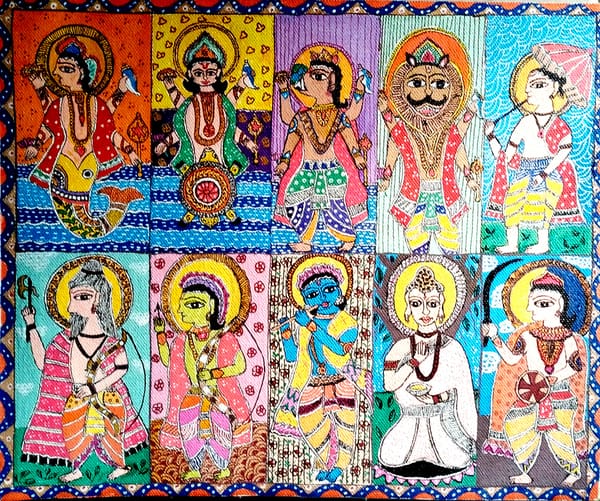
For practitioners of a religion that is reputed to have 330 million Gods, the phrase “Hindu Atheist” sounds like an oxymoron. One might assume it refers to a former Hindu who renounced their faith. However, in reality, a person can confidently identify as an atheist while remaining an orthodox Hindu — provided they accept the authority of the Vedas!
While Hinduism accommodates monotheism, polytheism, and pantheism, the core tradition is structurally closer to non-theism. Furthermore, the staggering count of 330 million gods actually stems from a literal mistranslation of the Sanskrit word koti, which means “categories,” but was misinterpreted as “millions”. The Vedic word koti translates to both “crore” (ten million) and “categories.” The texts originally implied 33 types of divine manifestations, not 330 million individual gods.
The Nasadiya Sukta: The Hymn of Creation

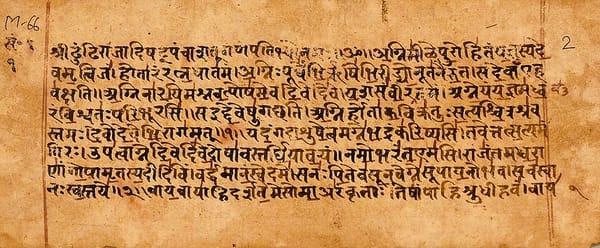
To understand the Hindu thought process regarding theism, we must look at the Nasadiya Sukta (Rig Veda, Mandala 10, Hymn 129). It is widely considered one of the most profound cosmological hymns in human history.
In the western world it is referred to as the “Hymn of Creation”. The text expresses radical skepticism regarding the origins of the universe. Below is a portion of one of numerous translations published on internet…
(Stanza 6)
But, after all, who knows, and who can say
Whence it all came, and how creation happened?
the gods themselves are later than creation,
so who knows truly whence it has arisen?
(Stanza 7)
Whence all creation had its origin,
he, whether he fashioned it or whether he did not,
he, who surveys it all from highest heaven,
he knows — or maybe even he does not know.
By declaring that “Gods themselves came later than creation”, the hymn effectively rejects the idea of God as a creator of the universe!
The final stanza expresses doubt about whether even a supreme entity in the highest heaven truly knows how the universe arose, or if the answer is even knowable!
This radical admission of ignorance displays immense intellectual humility. It positions the relentless pursuit of knowledge, rather than blind dogma, as the primary spiritual concern. Early Hindu society was intellectually sophisticated. It developed complex models of existence without relying on a divine creator figure. In fact, Stanza 6 bypasses the mention of a creator god entirely, suggesting the concept was not even a primary assumption at the time.
It does however mention Deva — exactly as it appears in the stanza’s Sanskrit text, but which in modern context is often interpreted to mean “God”. This raises the question about who or what a Deva is in Hindu traditions — a subject we will delve into in later essays.
Constructing a Model of Human Experience
Most philosophy and religion evolved to answer eternal human queries: Why do we suffer? How do we eliminate suffering? Who are we? Answers to these questions didn’t stand alone — typically a systemic model was developed to explain the entire human experience. Models from religious perspectives often involved one or more divine entities.
While many later Hindu traditions too incorporate a personal God to answer these questions, the foundational orthodox systems do not. Multiple models were developed, of which six classical schools of thought survive today and are known as the Darsanas (Points of View). All six accept the Vedas as their ultimate source of truth, yet they interpret the text to build vastly different philosophical models.
Samkhya Darsana
The Samkhya school is the oldest classical system and is explicitly non-theistic (Nirishvara). It argues that the universe is governed entirely by natural laws and cosmic evolution, requiring no divine creator.
Samkhya states that reality is composed of two eternal, independent principles:
- Purusha (Pure Consciousness): The silent, formless observer, present within every living being (one for each being), cannot be changed or destroyed.
- Prakriti (Matter/Nature): The dynamic physical world, including energy, time, the body, and the mind.
Matter evolves automatically when it comes into proximity with consciousness, much like iron filings moving near a magnet. Human suffering happens because Purusha becomes entangled with Prakriti, mistakenly identifying the eternal self with the transient body and ego. Liberation (Kaivalya) is achieved through strict logic and meditation, realizing that your true consciousness is completely separate from the physical world.
In fact, the non-theistic frameworks of Samkhya heavily influenced the development of early Buddhism. Historians note that the Buddha’s earliest spiritual teachers taught proto-Samkhya methods, and the famous Four Noble Truths of Buddhism structurally parallel the four diagnostic truths of the Samkhya school. While the Buddha took a different metaphysical path by rejecting the eternal self (Purusha), his radically atheistic approach — treating liberation as a psychological task of human effort rather than an act of divine grace — was directly shaped by this ancient Hindu school.
Mimamsa Darsana
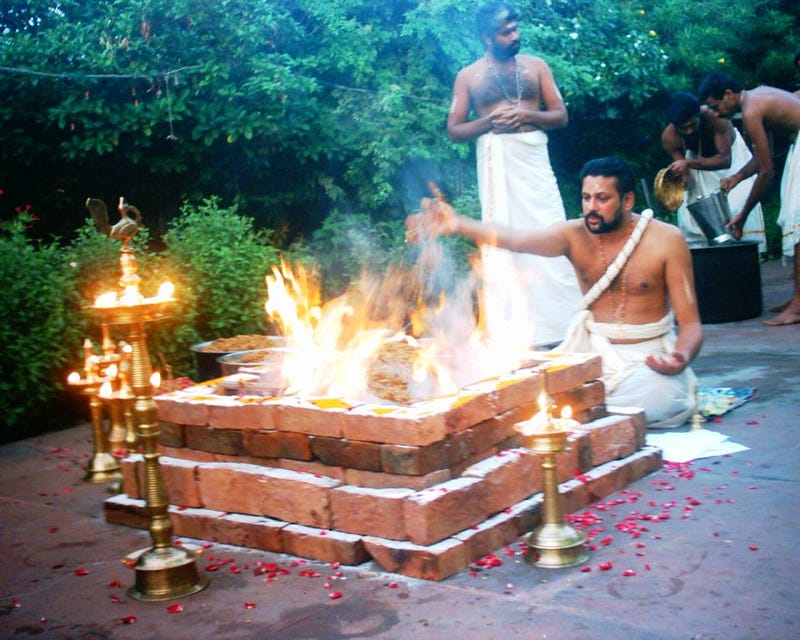
The Mimamsa, or Purva Mimamsa school, relies on the earliest ritualistic layers of the Vedas. This school of thought took systematic shape around the time that personal modern theism was gaining popularity. In direct opposition to that evolving trend, Mimamsa proposed a model that explicitly rejected the idea of God.
At the core of Mimamsa philosophy, Vedic ritual actions (Karma) are supreme. It is an ultimate paradox that such a fundamentalist school of thought is fiercely anti-theistic.
To a Mimamsaka (follower of Mimamsa), the universe is eternal — never created, and never to be destroyed. Therefore, there is no need for a Creator. The universe runs on a cosmic, moral blueprint of cause and effect governed entirely by the execution of Vedic rituals.
Mimamsakas viewed the universe as a machine that can be controlled through the technology of ritual. The precise phonetic vibrations of chanted hymns, combined with the physical action of ritual fire, drive this cosmic machine to produce desired reactions.
While modern practitioners often view the ritual fire as a vehicle carrying messages to heavenly gods, this is an evolution of belief popularized by later devotional traditions. To the original Mimamsakas, attributing personal divine will to the cosmos was a fundamental misunderstanding of how the ritual mechanics actually worked.
Non-Theism in Other Darsanas
Aside from Vedanta, which is the most prevalent philosophy today, none of the other Darsanas originally relied on God to build their models. This includes Yoga, Nyaya, and Vaisheshika.
As devotional Hinduism (Bhakti) grew vastly popular among the public in the early centuries, these highly intellectual schools faced immense pressure to incorporate God to remain culturally relevant.
- Nyaya & Vaisheshika: Originally, these were schools of pure logic and atomic physics that functioned perfectly without God. By the medieval period, their scholars engaged in fierce philosophical battles against Buddhist and Jain philosophers. To win these debates and appeal to the masses, they merged and developed highly sophisticated logical proofs for a creator God (Ishvara) who organizes the world’s atoms.
- Yoga: This school is the practical twin to Samkhya’s intellectual framework. While Samkhya relies on intellectual discernment to achieve liberation, Yoga provides the hands-on methodology. Patanjali, the compiler of this system, kept it highly pragmatic but intentionally added Ishvara into his Yoga Sutras as a useful, optional meditative tool to steady the mind. In Yoga, Ishvara did not create the universe, does not judge sin, and does not run the laws of karma. Instead, Ishvara serves a purely functional and psychological purpose.
Conclusion
While the dominant school of Vedanta does incorporate gods, Devas, or Ishvara, these entities are vastly different from the personal, external deities revered in Abrahamic religions. In Vedanta, God is ultimately not a separate cosmic judge, but an expression of the same non-dual consciousness that flows through everything.
Thus, the history of Hindu thought reveals a stunning truth: you can reject a creator God, view the universe as a self-sustaining machine, and rely entirely on natural laws — all while remaining a faithful practitioner of the Vedas. To be an āstika atheist is not a modern contradiction, but a return to some of the oldest, most sophisticated traditions of human philosophy.
What’s Next in This Series?
If ancient Hinduism could reject a creator God, what exactly did it mean when it spoke of Devas? In my next essay, we will unpack the linguistic and philosophical shifts that turned these ancient cosmic forces into modern deities.
Did you miss the last article?
Hinduism: Religion, Way of Life, or something else?
💬 Let’s discuss: Did the intellectual humility of the Nasadiya Sukta surprise you? Drop your thoughts, questions, or critiques in the comments below.